
TL;DR: Combining vLLM’s
OffloadingConnectorwith a per-token-head quantized KV cache corrupted generations on the very first forward pass — before a single offloaded block had been restored. Neither feature was broken. They simply disagreed about how KV memory is laid out: per-token-head quant carves inline scale views assuming a per-layer contiguous buffer, while the offload path allocates one cross-layer interleaved buffer shared by every layer. The merged fix is four lines — and after review, it moved out of the connector and into the allocation gate that every connector passes through.
“The final diff was four lines. Understanding why those four lines belonged there took considerably longer.”
Recently I contributed a bug fix that was merged into vLLM.
The patch is four lines in a single file.
That number is misleading. Getting there meant reading GPU memory layouts, KV cache allocation strategies, and a quantized attention backend — then discovering that every one of those components was individually correct.
The bug lived in the space between them.
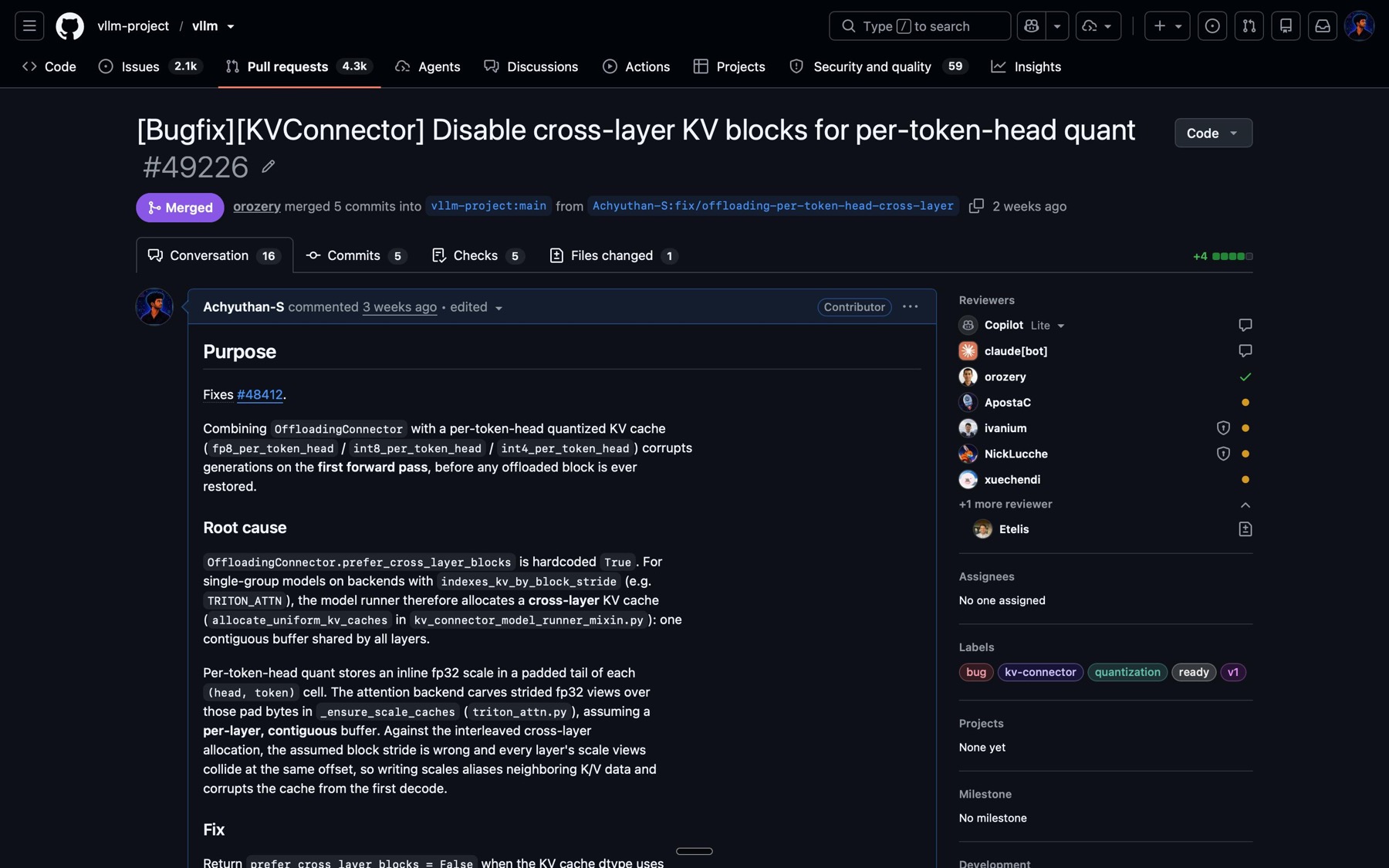
This is the story of PR #49226 (merged July 2026), fixing issue #48412.
The bug
The report was specific.
Enable two features together, and the model starts producing garbage:
OffloadingConnector— vLLM’s KV connector that offloads cached blocks out of GPU memory- a per-token-head quantized KV cache —
fp8_per_token_head,int8_per_token_head, orint4_per_token_head
Either one alone: perfectly fine. Both together: nondeterministic nonsense.
But the detail that reframed the whole investigation was when the corruption appeared.
It happened on the first forward pass — before any block had been offloaded, and long before any offloaded block had been restored.
That single observation eliminated the obvious suspects.
If the corruption predates the first restore, the bug cannot be in the offload transfer, the restore path, or the eviction policy. None of that code had run yet.
Something was wrong before the feature ever did any work.
Which meant the problem had to live in something that happens at startup.
Something like allocation.
The one thing you need to know about KV caches
A short detour, because the rest of the post depends on it.
During generation, a transformer recomputes attention over every previous token at every step. Doing that from scratch each time would be hopelessly wasteful, so the key and value tensors for past tokens are cached — the KV cache. It is usually the largest and most contended block of memory on the GPU.
Two consequences follow, and both matter here.
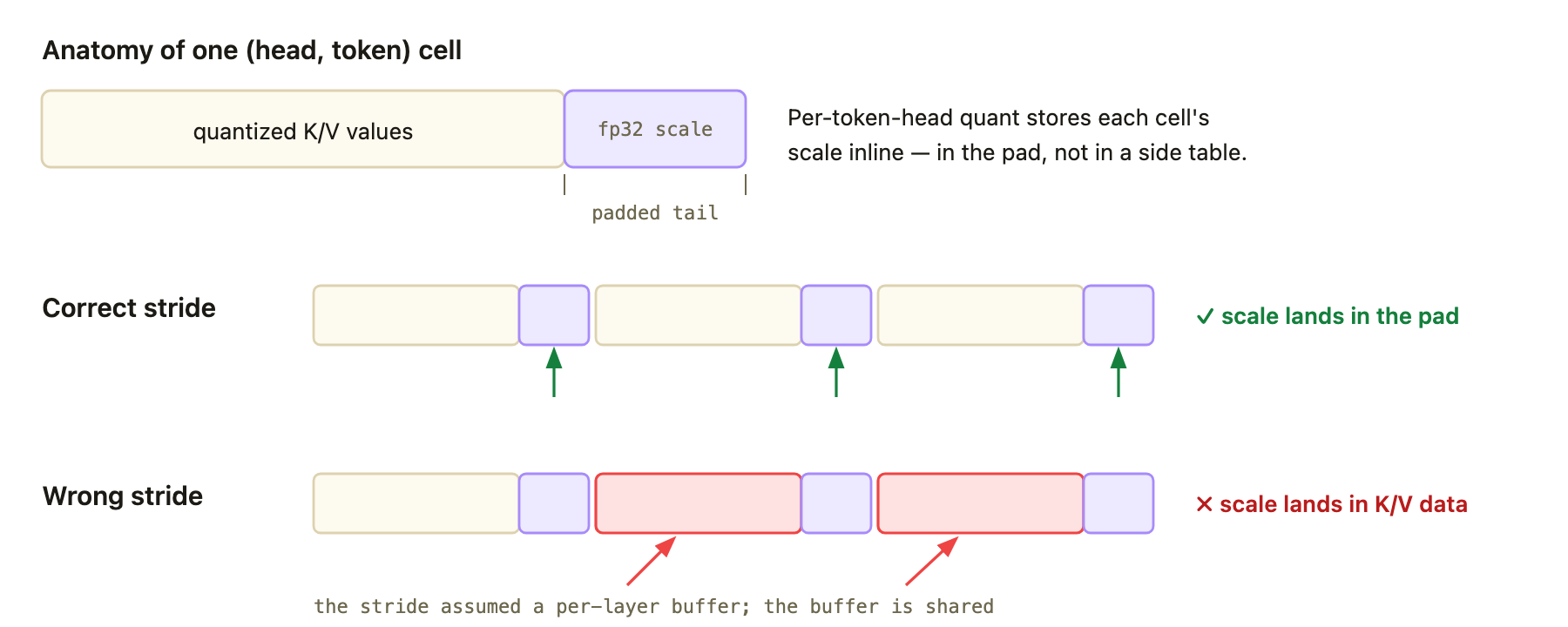
First, people compress it. Quantizing the KV cache to 8 or even 4 bits buys enormous capacity. But a quantized value is meaningless without its scale factor, so the scales have to live somewhere. In the per-token-head schemes, each (head, token) cell carries its own fp32 scale, stored inline — tucked into a small padded tail at the end of the cell.
Second, people move it. When GPU memory runs out, KV connectors offload blocks elsewhere and pull them back on demand. To make those transfers efficient, vLLM can allocate the cache as one cross-layer buffer — a single contiguous allocation shared by all layers — so a block for every layer can move in one operation instead of one transfer per layer.
Hold those two facts side by side:
- quantization writes small fp32 scales inside the KV allocation
- offloading changes how that allocation is shaped
Neither is wrong. But they are talking about the same bytes.
Why this bug was so hard to notice
Before the root cause, it’s worth asking why something this destructive stayed hidden.
Four reasons, and they compound.
Neither feature was broken. Every component passed its own tests, because every component was correct under its own assumptions. There was no incorrect line of code to find — only an incorrect combination.
It required a specific configuration. The corrupting path needs a per-token-head dtype, and a connector that prefers cross-layer blocks, and a single-group model, and a backend that indexes KV by block stride (such as TRITON_ATTN). Miss any one of those and everything behaves.
The symptom didn’t resemble the cause. Corrupted KV memory doesn’t announce itself. There’s no exception, no failed assertion, no NaN. The model simply produces fluent, confident, wrong tokens. It looks like a bad checkpoint or an unlucky sampling config — like a model problem. Nothing about the output points at a memory layout.
And it appeared before the suspicious code ran. The natural instinct is to instrument the feature you just enabled. But offloading hadn’t offloaded anything yet. The evidence pointed away from the code that looked guilty.
That combination — silent, configuration-dependent, and misattributed — is what kept it alive.
The root cause: two layouts, one assumption
Here is what actually happens.
OffloadingConnector declares prefer_cross_layer_blocks = True, unconditionally. For a single-group model on a backend with indexes_kv_by_block_stride, the model runner honors that preference and takes the allocate_uniform_kv_caches path in kv_connector_model_runner_mixin.py.
The result is one contiguous buffer, shared by every layer, with layers interleaved inside it.
Meanwhile, the attention backend needs somewhere to read and write those inline fp32 scales. In _ensure_scale_caches (triton_attn.py), it carves strided fp32 views over the pad bytes at the end of each cell.
To compute those strides, it assumes the layout it has always had: a per-layer, contiguous buffer.
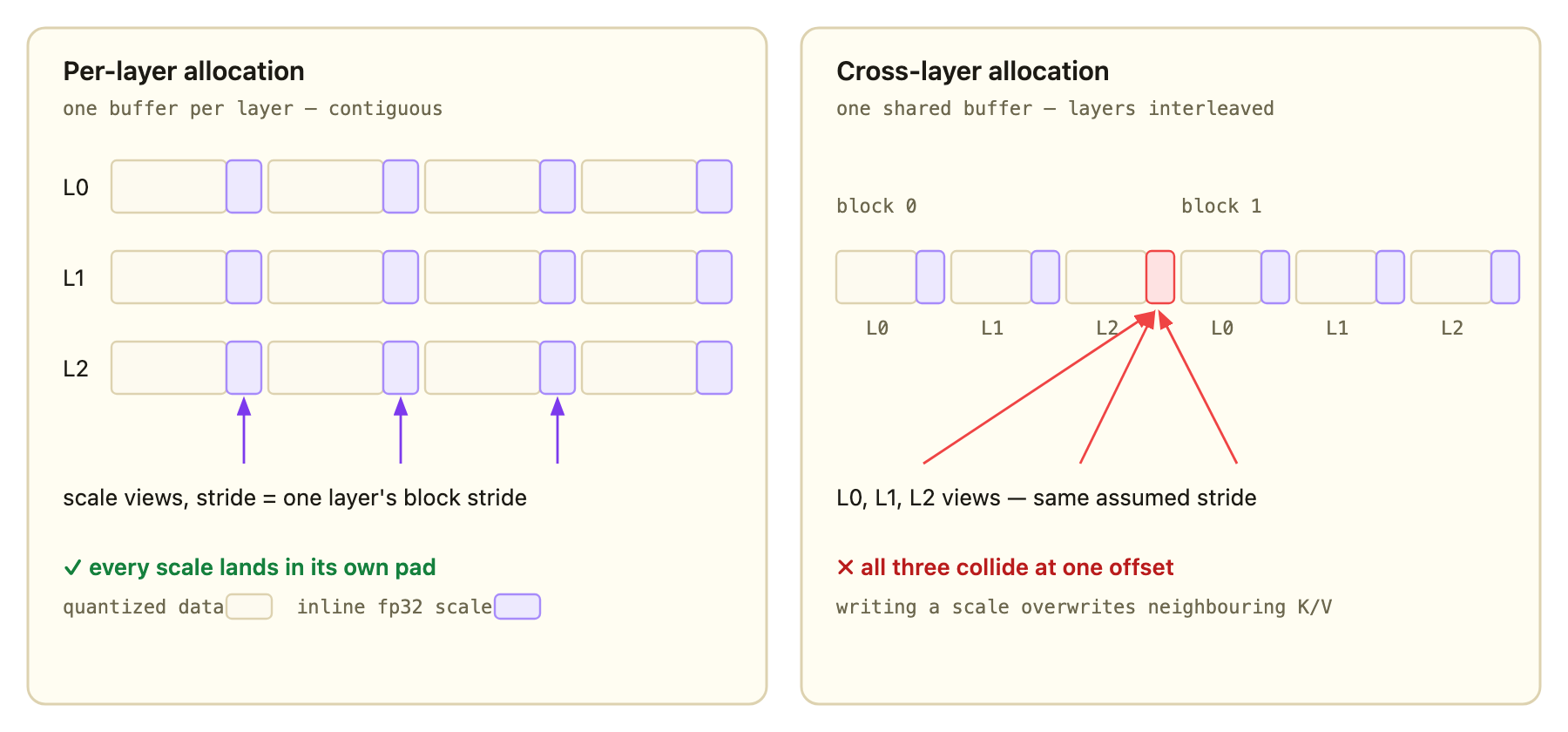
Against the interleaved allocation, that assumption fails.
The block stride the backend computes no longer describes the buffer it was handed. Every layer’s scale views land at the same offset instead of in their own regions — so they collide with each other, and with data that isn’t theirs.
Writing a scale then overwrites neighboring K/V bytes.
That’s the corruption. Not a transfer bug, not a quantization bug — a stride computed from the wrong mental model of the buffer, executing on the first decode.
There is also a piece of history here worth stating, because it explains why this wasn’t caught earlier.
An earlier PR — #48411, already merged — fixed a different per-token-head problem: the per-layer offload transfer width, where inline scales were being truncated mid-cell on restore. That fix explicitly scoped itself to the per-layer path and deferred the cross-layer allocation incompatibility to issue #48412.
So this wasn’t an overlooked bug. It was a known, filed, deliberately-sequenced follow-up. My PR is the second half of that pair.
The first fix
The offending value was easy to name once the mechanism was clear.
OffloadingConnector.prefer_cross_layer_blocks returns True even for dtypes that cannot survive the cross-layer layout. So my first patch made that property conditional: return False when the KV cache dtype uses per-token-head scales, and True otherwise.
The reasoning felt sound. The bug was reported against OffloadingConnector; the incorrect preference was declared by OffloadingConnector; so OffloadingConnector should stop declaring it.
It fixed the reported bug. Tests passed. Done, I thought.
One thing worth emphasizing about the shape of this fix, because it survived into the final version: it is a soft fallback, not a hard failure.
Offloading still works for these dtypes. They just take the per-layer path — which, thanks to #48411, is now correct. The only thing lost is the cross-layer transfer optimization, and only for per-token-head dtypes. Plain fp8 and every other configuration keep the fast path untouched.
Teaching the cross-layer allocation and _ensure_scale_caches to pack scales properly inside a shared buffer would recover that optimization — but that’s a much larger change on a much hotter path. Correctness first; the optimization can come back later, deliberately.
The review that made the fix smaller
This is the part of the PR I find most instructive.
The reviewer, Etelis, verified the bug end-to-end on an H100 — confirming that on main the combination produced nondeterministic garbage from the first pass, and that with the patch output became token-exact against a no-offloading reference, with restores working after a prefix-cache reset and bf16 still taking the cross-layer path.
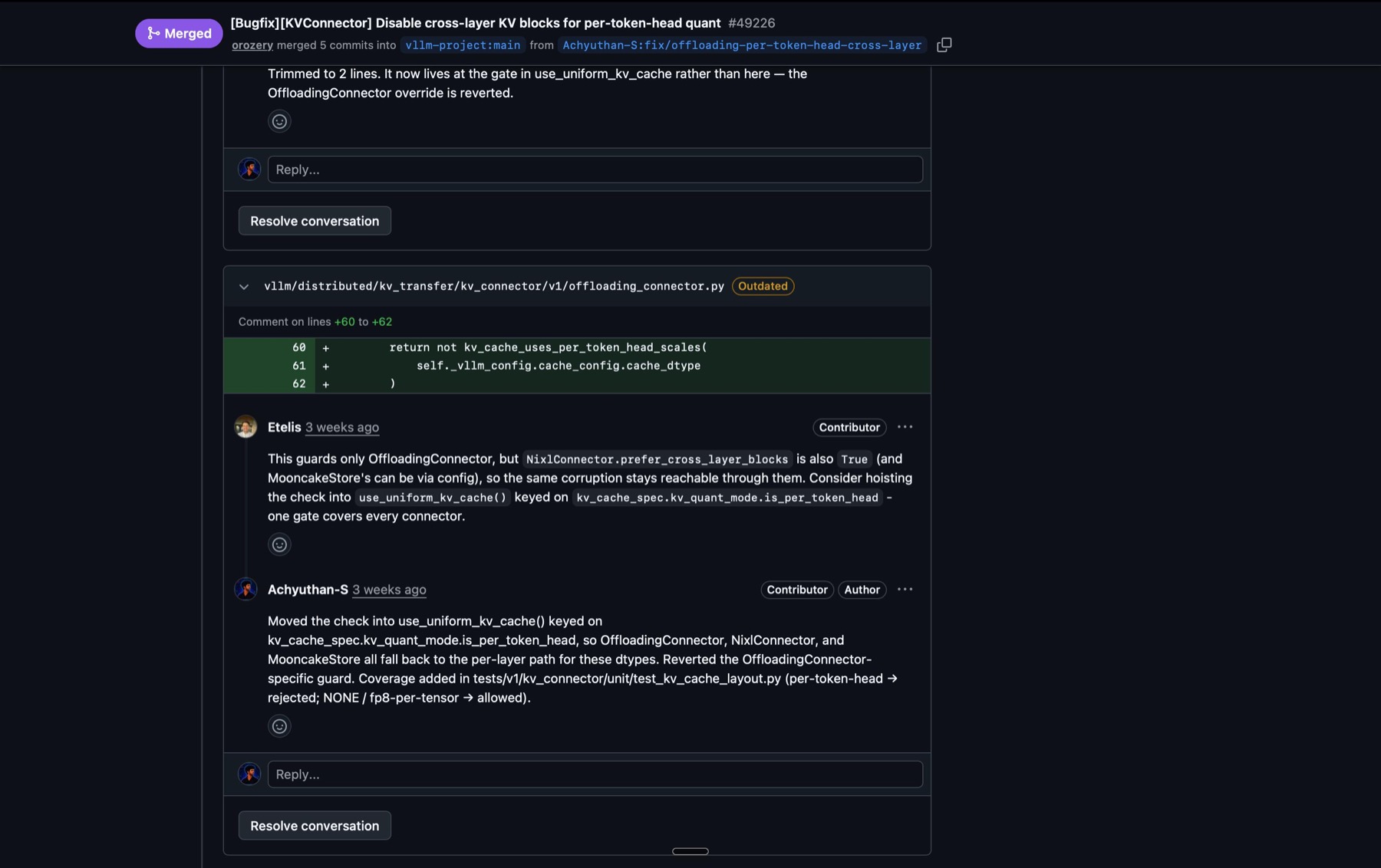
Then came the comment that changed the patch:
This guards only
OffloadingConnector, butNixlConnector.prefer_cross_layer_blocksis alsoTrue(and MooncakeStore’s can be via config), so the same corruption stays reachable through them. Consider hoisting the check intouse_uniform_kv_cache()keyed onkv_cache_spec.kv_quant_mode.is_per_token_head— one gate covers every connector.
He was right, and the point generalizes well beyond this PR.
I had fixed the bug where it was reported. But the bug wasn’t a property of OffloadingConnector — it was a property of the cross-layer allocation itself. Any connector that requested that layout with a per-token-head dtype would corrupt memory the same way. OffloadingConnector just happened to be the one someone filed an issue about.
Patching the connector treats the symptom at the site of the report. Patching the allocation gate states the actual invariant:
A cross-layer KV allocation is incompatible with inline per-token-head scales — regardless of who asks for it.
An invariant belongs at the place it is enforced for everyone, not at each of the call sites that might violate it.
So the check moved into use_uniform_kv_cache(), keyed on kv_cache_spec.kv_quant_mode.is_per_token_head. The OffloadingConnector override was reverted entirely, back to upstream.
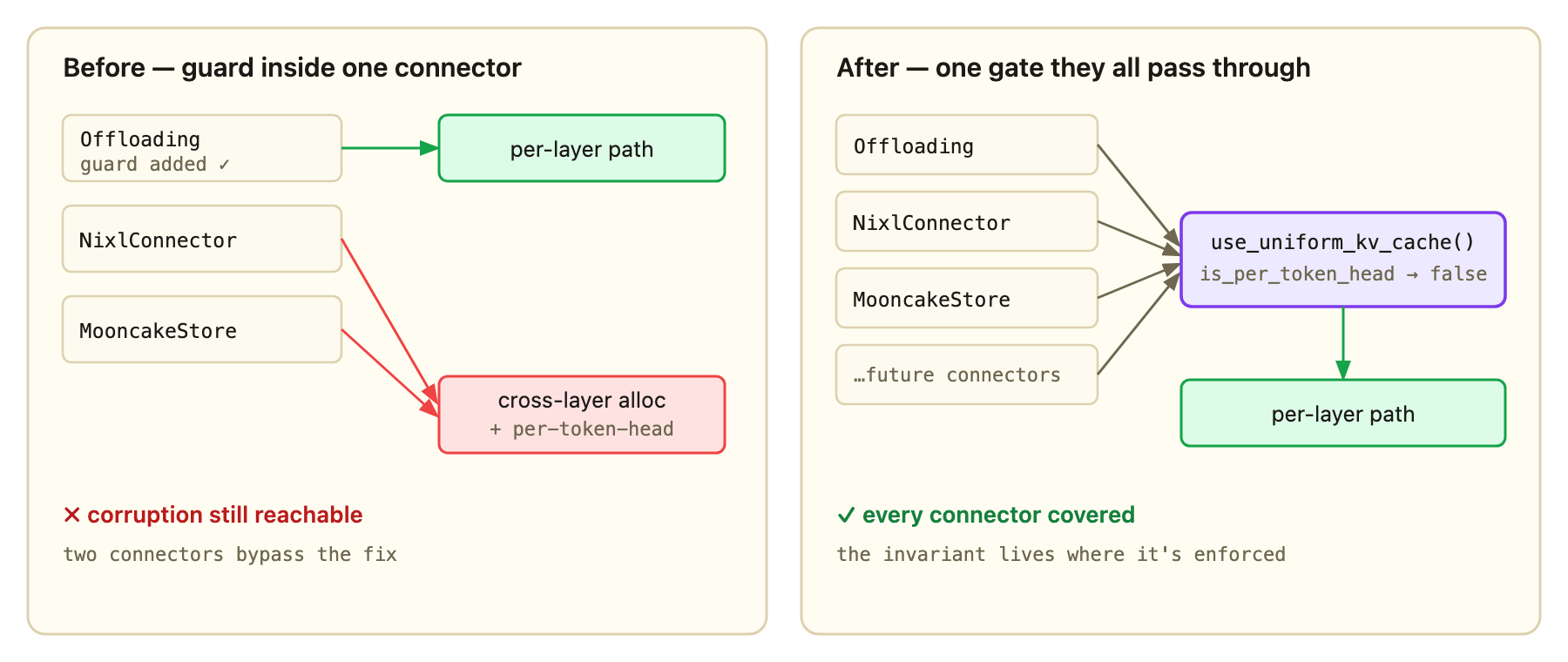
The fix got smaller and covered more.
OffloadingConnector, NixlConnector, and MooncakeStore all fall back to the per-layer path now — and so will any future connector, without its author needing to know this bug ever existed.
That’s what good code review does. It didn’t just find a flaw in my patch; it found the right altitude for the fix.
What landed
The merged patch is four lines in one file — vllm/v1/worker/kv_connector_model_runner_mixin.py:
  kv_cache_spec = attn_group.kv_cache_spec
  if not isinstance(kv_cache_spec, AttentionSpec):
      return False
+ # Per-token-head quant carves inline-scale views that assume per-layer
+ # contiguous KV buffers; the cross-layer layout breaks this and corrupts KV.
+ if kv_cache_spec.kv_quant_mode.is_per_token_head:
+     return False
  return kv_cache_spec.indexes_kv_by_block_stride
Two lines of comment, two lines of logic. Everything else in this post is why those four lines say what they say — and why they live there rather than three levels down.
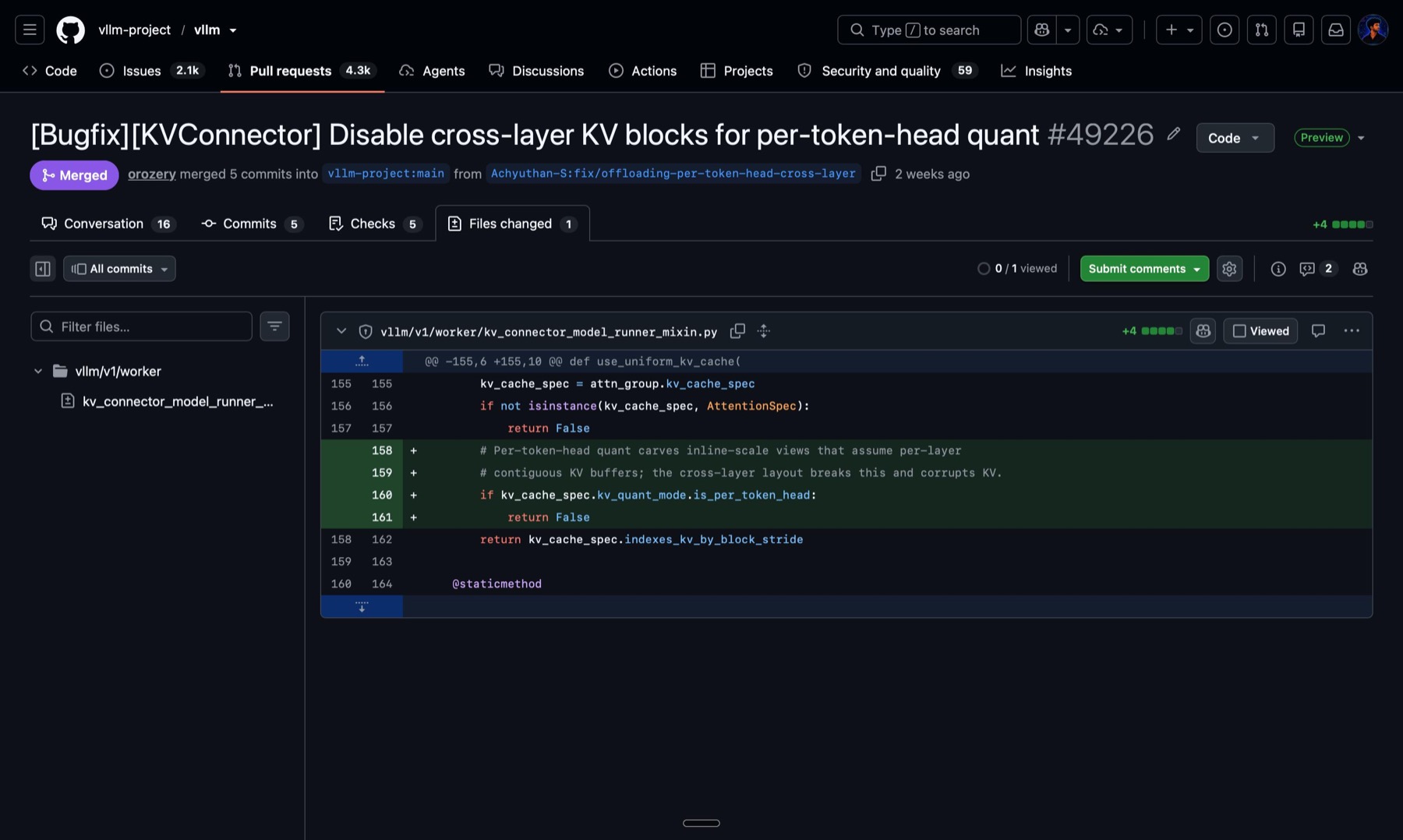
It went through five commits and two rounds of review. Along the way it lost things: my connector-level override, and the unit tests I’d added for the routing behavior — the maintainer, orozery, asked for the tests to be dropped since end-to-end behavior had already been verified on hardware during review.
The final artifact is smaller than every intermediate version of it.
I’ve come to think that’s often a good sign in systems code.
Lessons
A small diff is not a small change. Four lines can encode a genuinely deep fact about a system — here, that a memory layout and a quantization scheme make incompatible claims on the same bytes. Line count measures typing, not understanding.
Memory layout is part of the interface. _ensure_scale_caches didn’t document “I require a per-layer contiguous buffer,” but it required it just as surely as if the constraint were in a type signature. Unwritten layout assumptions are load-bearing, and they break silently — because nothing in the type system is watching them.
Fix bugs at the altitude of the invariant. The reported bug was in a connector. The actual invariant belonged to the allocator. Fixing it where it was reported would have left two known-reachable paths to the same corruption, waiting for someone else to file the same issue from a different direction.
Correctness beats optimization, but the trade should be explicit. Falling back to the per-layer path costs a real performance optimization. Saying so plainly in the PR — what’s lost, for which dtypes, and what it would take to recover it — turns a silent regression into a documented, revisitable decision.
And not every red build is your fault. A fair amount of the effort here went into reading CI rather than writing code: of the failures on the final runs, most were Buildkite infrastructure problems (agents lost mid-run, an environment hook failing before tests ever started) and the remainder were pre-existing failures on main in areas the patch never touched. Learning to tell an infrastructure flake from a real regression — and to say so precisely, with evidence — is its own contributor skill.
Final thoughts
The thing I keep returning to is that nobody wrote a bug here.
The quantization code correctly stored its scales inline. The attention backend correctly carved views over them. The connector correctly asked for the layout that makes its transfers fast. The allocator correctly provided it.
Every component was right. The system was wrong.
That’s a category of failure you only find in systems software — where correctness isn’t a property of any single file, but of the agreement between them. And when that agreement is implicit, nothing fails loudly. It just quietly produces the wrong answer, at speed, with total confidence.
Which, in an inference engine, is exactly the worst way to be wrong.